
Let’s Make Magic!
A Disney Institute Reflection by Matt Baram
I learned, I laughed, I collected awesome Disney swag, and since I was still recovering from emergency gallbladder surgery, I stared longingly at a buffet of mouthwatering Disney delicacies I was unable to eat.
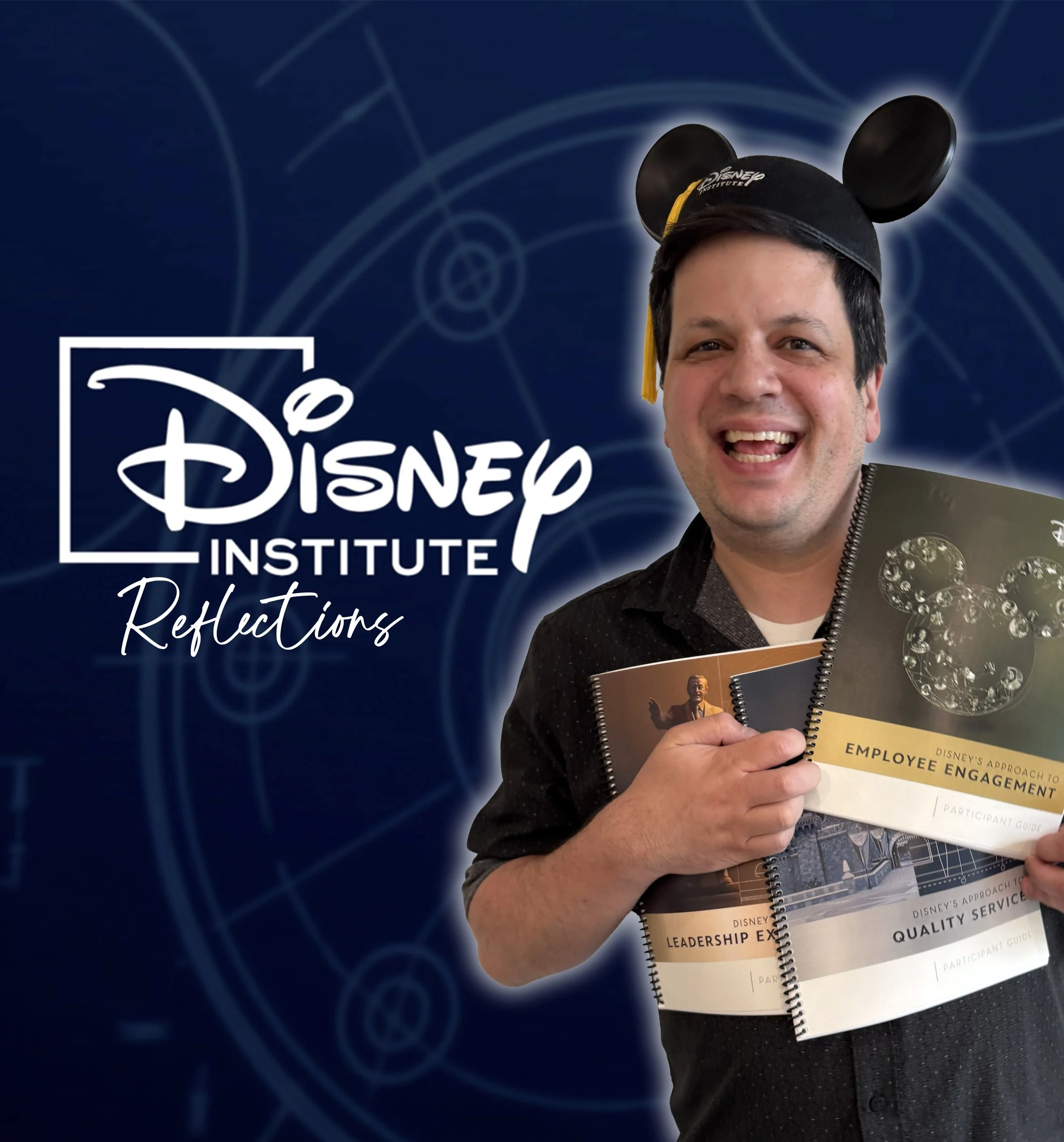
Yes, in February of 2025, thanks to professional development funds from the Wexner Field Fellowship, I attended the Disney Institute in Anaheim - a 3-day deep dive into the secrets of Disney’s customer service, employee engagement, and leadership excellence.
I left inspired, motivated, and completely overwhelmed. Whether or not Disney always walks the walk, they darn sure talk the talk. And I did my best to listen.
In the year and a half since, I’ve tried to implement as many of these lessons as possible (my staff lovingly, or at least jokingly, pretend to take a shot every time I bring up the Disney Institute).
And now, I’m excited to share with you some of the Disney magic that continues to impact how I run my organization. Whether you work in Jewish non-profit, or elsewhere, may they help you and your workplace create a little more magic!
Know your common purpose: Are we laying bricks or are we building a home?
Disney trains every single cast member (employees), from the person selling churros to the person cleaning toilets, that their role is an essential component of creating magic. And they’re right. Every job has elements that aren’t so glamorous, but when we are bought into an organization’s common purpose, it’s a heck-of-a-lot easier to complete those tasks with excellence and intentionality.
But don’t assume everyone is bought in or even on the same page about your common purpose. One of the motifs of the Disney ethos is that culture and values need to be taught and reinforced over and over and over again.
At Hillel 818, we make it clear that we are not in the business of running programs or operating a building. Our business is using Jewish community to change lives for the better.
That means the most tedious tasks - filing receipts, washing dishes after a program, refilling the toilet paper, writing a grant report – still matter because our mission can’t be accomplished unless these things are done with excellence.
Celebrate and acknowledge the behaviors you want to be consistent:
I give a lot of public praise to my employees… when they do something extraordinary. It’s so easy! Do something amazing and you’ll receive all the adulation you can handle.
But Disney teaches that praising the extraordinary isn’t nearly good enough. The argument is this: celebrate and reinforce expected behavior or else your team won’t know it’s expected.
And if you don’t, you’re leaving your culture up to chance.
One way we’ve tried to reinforce culture at Hillel 818 is through our “Kol HaKavod” cards (Hebrew for “all of the honor”) that we try to hand out to 2-3 employees every day with thanks for completing ordinary tasks.
Praise only the extraordinary if you dare, but don’t be surprised when your ordinary expectations aren’t met.
Mistakes are Successful Failures:
Legendary UCLA basketball coach John Wooden famously said that, “If you’re not making mistakes, then you’re not doing anything.”
Still, most of us are terrified to make mistakes! Which is why I’ve found lasting power in Disney’s framing: mistakes aren’t failings – they’re successes. Mistakes mean that the system is working - that we’re learning, growing, and gaining strength.
Seriously, blessed be our mistakes!
At my organization, I try my best never to get upset by well-intentioned mistakes. Lord knows I make mistakes all the time. As long as they aren’t mistakes of laziness or apathy, I view our mishaps as a sign of organizational health.
It means we’re doing hard things.
Define your values or someone else will:
Here’s a simple exercise for your next staff meeting: ask everyone to write down the values they believe are most important to your organization. Chances are there will be some overlap and also a surprising amount of diversity.
“Some overlap” might sound great, but in the case of your company’s values that just isn’t good enough. If everyone thinks your company’s values are something different, then your organization can’t possibly be living its values.
Company values need to be articulated, taught, modeled, and reinforced.
At Disney, every cast member can tell you the organization’s 5 keys, in order (Safety, Show, Courtesy, Efficiency – all through a lens of diversity). Those values help determine decision making, hiring, problem solving, disputes, and so much more.
At Hillel 818, we have spent a lot of time as a team defining our values – organizationally and as a staff. And talking about them has become an integral part of our staff meeting agenda.
Hire for culture, not for skills:
Hiring managers everywhere - hear these words: skills and experience are overrated.
Skills can be taught. Experience can be gained. A bad cultural fit, on the other hand, is excruciatingly difficult to navigate.
Disney defines culture as, “the way we do things around here.” But as with everything else at Disney, good culture is by design.
At Disney, they even keep track in interviews whether a prospective cast member smiles. Which makes sense – Disney wants friendly and welcoming cast members. It’s essential to their culture.
Two summers ago, I was hiring for 5 positions at Hillel 818. With Disney Institute in mind, I made a list of the cultural attributes and values that were most important for each position – things like collegiality, resourcefulness, creativity, organization, friendliness – and then created a scorecard for each candidate based on that criteria.
Relevant Experience was only one of the 10 scorecard areas.
We now do an informal version of this as we consider new members of our Board of Directors. I believe this style of hiring was partly responsible for us winning Hillel International’s “Great Place to Work” award in 2024.
Hit ‘em in the kishkes (my language – not Disney’s).
A cynic might suggest that Disney weaponizes nostalgia in pursuit of the almighty dollar. Rationally, I suppose, I’m one of those cynics.
And was taking my 5 year old to Disney for his first time one of my most joyful moments so far as a parent?
Yes.
And therein lies Disney’s superpower: they know exactly how to make us feel something.
Emotionally engaged customers are 3x more likely to recommend your company, 3x more likely to repurchase, and much less price sensitive.
In other words – we have to hit ‘em in the kishkes!
And the two greatest tools for making that emotional connection? Storytelling and relationships.
We see ears perk up at Hillel when we talk about how 25% of our Jewish students face some level of food insecurity. We see hearts open up when they hear about the student who asked to take home leftover fruit because “her family can’t afford fresh fruit at home.”
And it’s why at Hillel 818, we invest in relationship building. Through coffee conversations, mentorship, and peer to peer relationships, we are steeped in what my friend Professor Ron Wolfson long ago dubbed “Relational Judaism” - the powerful idea that people might come to a Jewish organization for the services or programs but stay for the relationships.
It’s always your problem:
One of my favorite parts of the Disney ethos:
It may not be our fault, but it’s always our problem.
In order for mistakes to be successful failures, we must become experts at recovery. And the best recovery, according to Disney, both solves the problem and reconciles the relationship.
Sounds simple enough, right?
Well let’s be honest: most organizations (and people) are terrible at recovery.
Why? Because none of us want to be blamed for things that aren’t our fault. And in personal relationships, you can hold your ground where you feel comfortable. But as an organization, and especially for those of us in the community-building business, it’s not about assigning blame.
It’s about assigning care.
One typical example from Hillel - it’s not our fault when two students don’t get along and aren’t comfortable being in community with each other. But it’s absolutely our problem. A student has to feel valued and loved by the organization, even and especially in those moments where they don’t feel as comfortable here.
One interesting tidbit in this section of the Disney Institute that stuck out for me: don’t ever make an upset customer repeat the story again – the second, let alone third, telling is always worse and more dramatic than the first.
Welcoming isn’t a feeling, it’s a planned strategy.
This past summer, the Hillel 818 staff mapped out the typical student experience – from the first time they find out we exist through when they attend their second Hillel 818 program.
We highlighted every possible touchpoint in that timeline, had an honest conversation about what currently happens, and then chose a few to prioritize for improvement.
From those conversations, we made significant changes in our building’s lobby: we made hangout areas cozier, signage clearer, and the stories told through the lobby’s various displays more intentional.
We’re two weeks into the school year, and our students are using our lobby as a hangout space more than ever before.
These strategies were taken directly out of the Disney handbook. They are the true masters of intentionally mapping out touchpoints.
Disney knows exactly how many cast members you will interact with from the time you enter the parking garage until you go on your first ride.
They know exactly how to find your car if you forget where it is.
Garbage cans are placed 30 steps from each other so you always have a convenient place to throw things away.
Every cast member, especially the maintenance staff, is an expert on giving directions.
Look, Disney is expensive, crowded, has long lines, and the heat can be torture.
And yet, for millions upon millions of people it’s the happiest place on Earth.
This is no accident.
And that’s, for me, the biggest takeaway from the Disney Institute 18 months later:
If it’s not on purpose, it’s by accident.
The true magic of Disney doesn’t come from Tinkerbell’s fairy dust. It’s thousands of intentional decisions, big and small, that work together harmoniously to create the Disney experience so many of us love and cherish.
You and your org can create magic, too. I hope this helps.